


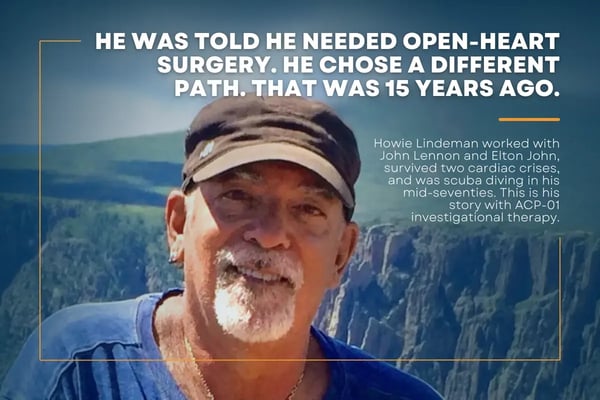
Howie Lindeman has spent his career in rooms where history was being made. As a music industry professional, he worked alongside John Lennon, Elton John, and Roberta Flack. He built his reputation in the recording studios of New York and spent decades on the road with artists who sold out arenas. He also taught scuba diving.
None of that was supposed to continue after 1989.
That was the year, living in Maui, that Howie had his first heart attack at 39. He did not feel the crushing chest pain people associate with cardiac events. He just felt profoundly, inexplicably unwell. By the time he was diagnosed with ischemic cardiomyopathy, the road he had been on for a decade was suddenly in question.
"I didn’t feel the classic chest pain. I just felt green. I knew something was very wrong."
Ischemic cardiomyopathy is a condition in which the heart muscle is weakened by chronically inadequate blood supply. In Howie’s case, it was compounded by a family history of congestive heart failure. He managed the condition for nearly two decades. Then, in 2008, it progressed to the point where a decision could no longer be deferred.
The Choice He Made in 2008
By his late fifties, Howie was facing the recommendation for traditional open-heart surgery. The conventional path was laid out. He understood the risks. He also understood that he was not ready to stop.
A friend told him about an investigational therapy being studied for ischemic heart disease: an autologous stem cell treatment that used a patient’s own blood cells to stimulate new blood vessel growth in damaged cardiac tissue. The research was early. The numbers of patients treated globally were small. Howie became one of approximately the first 50 people in the world to receive ACP-01, developed by Hemostemix.
The procedure involved a blood draw, laboratory processing of his own cells, and their delivery back into the ischemic tissue of his heart.
"I felt a difference almost immediately. Like something had changed inside."
He describes the experience as a feeling of warmth and ease moving through his chest, a sensation he had not anticipated and could not fully explain. Within weeks, he noticed that his energy had returned in ways it had not for years.
The Decade That Followed
For the next ten to eleven years, Howie did not slow down. He continued working demanding road schedules with Roberta Flack and other artists, often surviving on four hours of sleep a night in the way touring musicians and their crews always have. He kept his scuba diving certification current and used his days off on tour to explore wrecks and reefs around the world.
|
What Howie did in the decade after ACP-01 treatment: Continued international touring with major recording artists Maintained his scuba diving instructor certification Dived reefs and wrecks across multiple countries Did not require major cardiac intervention for over ten years |
He is clear that he is not describing a cure. His heart disease did not disappear. He was managing it, as he always had. But he was managing it while living at full intensity, which is something his prognosis in 2008 had not promised him.
The Emergency, and What Came After
About seven years ago, Howie’s life was turned over by Hurricane Irma. He lost his home. The stress of the displacement and the move to North Carolina took a toll. He required emergency quadruple bypass surgery.
The surgery was serious. The recovery from the chest healing was difficult and slow. But his doctors noted something: the underlying strength of his heart muscle was higher than they had expected given his disease history. Years of improved circulation, sustained in part by the new vessel growth from his earlier cell therapy, had preserved cardiac muscle that might otherwise have deteriorated further.
"I’m operating on aftermarket parts. But I feel as capable as I did in my fifties."
Now 74, Howie remains active in the music industry and continues to dive, though he limits his depth to around 60 feet as a sensible precaution. His primary physical limitation today is not his heart. It is a knee injury from a car accident two years ago.
Why He Tells This Story
Howie Lindeman speaks at seminars and webinars, not because he was asked to represent a company, but because he believes he has a responsibility to.
He has met patients who were told their only options were surgery or decline. He was one of them. He chose an investigational path when it was far less established than it is today. And he lived a decade of full life because of that choice: touring, diving, working, and being present for the people who depended on him.
He describes it as his duty. Not a story of miraculous recovery. A story of information, available at the right moment, that changed what was possible.
|
Important note on Howie’s experience: ACP-01 is investigational and not approved by Health Canada, the FDA, or any other regulatory authority for the treatment of cardiomyopathy, heart failure, or any other condition. Individual outcomes vary. Howie’s experience does not represent a typical result or guarantee future outcomes for any patient. This account is drawn from Howie Lindeman’s own shared experience and is published with his knowledge. |
|
If Howie’s story raises questions about your own situation The Hemostemix clinical team works with patients facing cardiac ischemia, ischemic cardiomyopathy, refractory angina, and advanced vascular disease. If you want to understand whether an investigational approach may be relevant to your specific history, our clinical team reviews every inquiry personally. Email: careteam@hemostemix.com Call: 888-396-2402 |
|
Disclaimer: ACP-01 is investigational and not approved by Health Canada, the FDA, or any other regulatory authority. This article is educational only and does not constitute medical advice. Individual patient experiences vary and do not predict outcomes for other patients. Always consult your physician before making any treatment decisions. |