


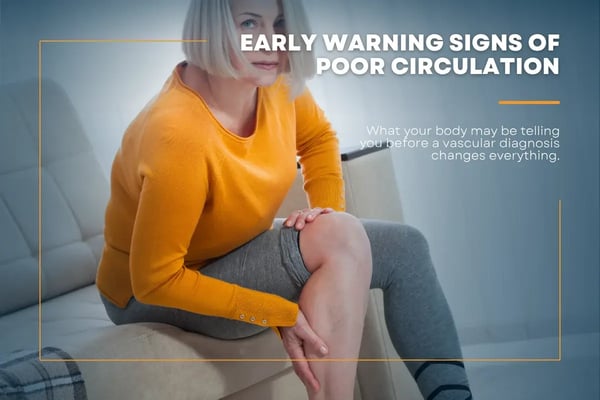
You may have noticed something off for a while. A foot that feels colder than the other. Leg cramps that show up on a walk and disappear when you stop. A small cut on your ankle that takes weeks to close. Each of these, on its own, is easy to dismiss. Together, they can be early signals of peripheral arterial disease, a condition affecting the arteries that carry blood to your legs and feet.
PAD affects millions of people, and it is one of the most underdiagnosed cardiovascular conditions in the world. Part of why it goes undetected for so long is that the early warning signs look like other things. Aging. Tired muscles. Dry skin. The body compensates quietly for a long time before symptoms become impossible to ignore.
Knowing what to look for early matters. Not because the diagnosis is immediately urgent in every case, but because the range of options available to you is much wider when PAD is caught before it advances.
What Poor Circulation Actually Feels Like
Reduced blood flow to the legs does not always announce itself dramatically. In early-stage PAD, the arteries are narrowing but the body finds ways to cope. Symptoms appear during activity, then ease at rest. They are easy to attribute to something else.
The most common early signs include:
- Cramping or aching in the calf, thigh, or hip during walking that clears with rest. This is called claudication, and it happens because narrowed arteries can supply enough blood at rest but not enough when muscles need more oxygen during movement.
- One foot or leg that feels noticeably colder than the other.
- Skin on the lower leg that looks shiny, thin, or pale, or that loses hair over time.
- A weak or absent pulse in the foot.
- Wounds on the feet or lower legs that take longer to heal than they should.
- Numbness or heaviness in the legs that is not explained by activity level.
Not everyone experiences all of these. Some people have significant PAD with almost no symptoms until a wound appears that will not close.
|
A simple, non-invasive test called an ankle-brachial index (ABI) can detect arterial disease in about 15 minutes. If you have risk factors and have not been tested, it is worth raising with your doctor. |
Who Should Pay Attention
PAD is more common in people over 60, but it does not only affect older adults. The major risk factors include long-term smoking, type 1 or type 2 diabetes, high blood pressure, elevated cholesterol, chronic kidney disease, and a family history of vascular or heart disease.
Having more than one of these risk factors significantly accelerates how quickly the disease can develop. If any of these apply to you and you have been noticing symptoms in your legs or feet, a conversation with your doctor is the right next step. A vascular evaluation is not an overreaction. It is how you keep your options open.
For many patients, the symptoms described above are the first chapter of a longer story. Understanding what they mean, and acting on them before the disease progresses, is the most useful thing you can do right now.
|
Some patients in this situation are exploring investigational approaches focused on restoring blood flow at the cellular level. Our guide on When PAD Treatments Stop Working: What Patients Need to Know Next Learn what to do when medication, stenting, and bypass surgery stop controlling your symptoms. |
|
Disclaimer: This article is educational only and does not constitute medical advice. Individual outcomes vary. Always consult your physician before making any treatment decisions. |
|
Hear From Someone Who Has Been There Two patients. Two diagnoses. Two decisions that changed everything. Half of His Heart Died in That Attack. The Other Half Had Other Plans. He Was Told He Needed Open-Heart Surgery. He Chose a Different Path. That Was 15 Years Ago. |