


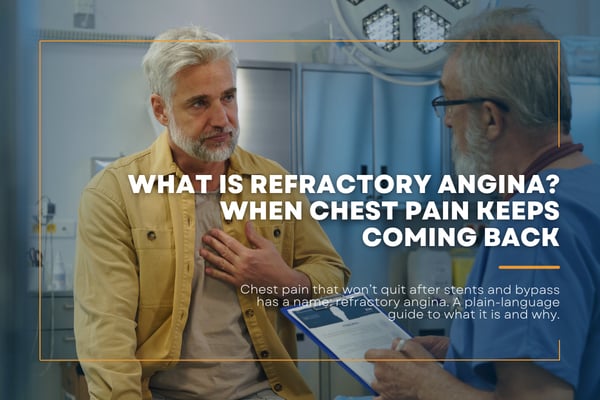
If you have been living with angina, you already know it is more than chest pain. It is the pause before the stairs. The quiet math of how far you can walk before it starts. The way it narrows a life, one avoided activity at a time.
For most people, angina can be managed. Medications, lifestyle changes, and procedures like stents or bypass surgery often bring real relief. But for some, the chest pain keeps returning even after all of that has been tried. That is what doctors call refractory angina, and understanding it is the first step to knowing what to ask next.
What "refractory" actually means
Refractory simply means resistant to treatment. Refractory angina is angina that persists despite maximal medical therapy, meaning you are already on the standard medications at the doses your doctors can safely prescribe, and you may have already had procedures to restore blood flow.
Clinically, it is often described as chest pain that continues to occur, frequently several times a week, even though you are taking two or more anti-anginal medications and have exhausted the usual procedural options. In plain terms: everything standard has been tried, and the pain is still there.
This is not a sign that you did something wrong, or that you failed to follow the plan. It means the underlying problem has not been fully reached by the tools used to treat it.
Why it keeps coming back
Angina happens when part of the heart muscle is not getting enough oxygen-rich blood. Most treatments focus on the large coronary arteries, the major vessels you can see on an angiogram. Stents prop open a narrowed artery. Bypass surgery reroutes blood around a blockage. Medications relax vessels and reduce the heart's workload.
These approaches work on the plumbing that can be seen and reached. But the heart is also fed by a vast network of much smaller vessels, the microvasculature, far too small for a stent or a surgeon's graft. When the problem lives in those small vessels, the standard tools cannot reach it. The large arteries may have been successfully treated, and yet the chest pain continues, because the trouble is downstream, in vessels no procedure can open.
This is one reason refractory angina can be so frustrating. On paper, the major arteries look addressed. In the body, the pain persists.
Living with it
Refractory angina is a chronic condition, and the people who live with it are often managing more than physical symptoms. There is the limitation itself, and there is the weight of being told, after everything, that the standard options have run out.
Day to day, management focuses on controlling symptoms and protecting quality of life: careful medication management, cardiac rehabilitation when appropriate, pacing of activity, and close work with a cardiology team. Some people find meaningful relief through these measures. Others continue searching for something more.
You are allowed to keep asking
Being told that standard treatment has been exhausted is not the same as being told nothing can be done. Medicine does not stand still, and the understanding of refractory angina, especially its roots in the smallest vessels of the heart, continues to evolve.
If you or someone you love is living with chest pain that has not responded to the standard playbook, it is worth understanding the condition fully, asking specific questions, and staying informed about where the research is going.
The more you understand what is actually happening in the heart, the better the questions you can ask.
|
YOUR NEXT READ When Stents and Bypass Aren't Enough: Understanding No-Option Angina You understand what refractory angina is. Here is what it means to be told the standard options have run out, and what questions come next. Read the next article → When Stents and Bypass Aren't Enough: Understanding No-Option Angina |
This article is educational only and does not constitute medical advice. Always consult your physician before making any treatment decisions.