


Support for Patients With Reduced Blood Flow From Advanced PAD, CLTI, and Ischemia
Support for complex PAD and CLTI cases where reduced blood flow has led to non‑healing wounds or progressive ischemia, alongside investigational evaluation programs for vascular dementia, chronic pain, cardiovascular ischemia, and ongoing research into long-term outcomes in ischemic disease.
Support for Patients With Reduced Blood Flow From Advanced PAD, CLTI, and Ischemia
Support for complex PAD and CLTI cases where reduced blood flow has led to non‑healing wounds or progressive ischemia, alongside investigational evaluation programs for vascular dementia, chronic pain, cardiovascular ischemia, and ongoing research into long-term outcomes in ischemic disease.
When to Consider a Clinical Evaluation Pathway
Progressive ischemia or worsening perfusion findings after revascularization
Rest pain or ischemic pain that remains unresponsive to conventional management
Limited or no remaining revascularization options, including cases where further intervention is not feasible or not expected to improve reduced blood flow
Persistent reduced blood flow documented through imaging, hemodynamic testing, or clinical examination
Limb‑threatening ischemia requiring multidisciplinary review to determine next steps
Patients seeking investigational evaluation after exhausting standard care pathways for ischemia‑related conditions
When to Consider a Clinical Evaluation Pathway
- Non‑healing ischemic wounds that persist despite guideline‑directed wound care and prior interventions
- Progressive ischemia or worsening perfusion findings after revascularization
- Rest pain or ischemic pain that remains unresponsive to conventional management
- Limited or no remaining revascularization options, including cases where further intervention is not feasible or not expected to improve reduced blood flow
- Persistent reduced blood flow documented through imaging, hemodynamic testing, or clinical examination
- Limb‑threatening ischemia requiring multidisciplinary review to determine next steps
- Patients seeking investigational evaluation after exhausting standard care pathways for ischemia‑related conditions
Scientific Rationale for Investigational Evaluation
Scientific Rationale for Investigational Evaluation
ACP-01 Clinical Programs and Indications
ACP‑01 has been evaluated or is currently under investigation across multiple vascular and ischemia‑related conditions where reduced blood flow, microvascular decline, or impaired tissue repair play a central role. Research programs have included advanced PAD and CLTI, as well as broader ischemic and neurovascular conditions such as vascular dementia, chronic pain, cardiovascular ischemia, and ongoing research into long-term outcomes in ischemic disease.
These programs are designed to assess safety, biological activity, and potential mechanisms of action in patients who have exhausted standard care pathways. The chart below outlines ongoing clinical studies across these investigational areas.
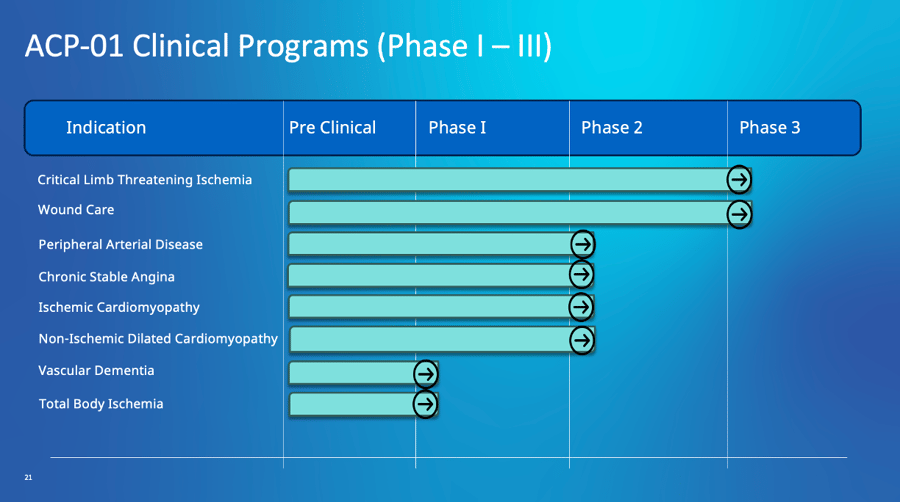
These programs represent structured clinical development efforts targeting limb ischemia, myocardial ischemia, and vascular-related cognitive impairment. ACP-01 remains investigational in all indications.
Mechanism of Action: Autologous Angiogenic Cell Therapy
Mechanism of Action: Autologous Angiogenic Cell Therapy
ACP-01 comprises autologous angiogenic precursor cells derived from a patient’s peripheral blood. Cells are isolated and prepared under controlled laboratory protocols prior to re-administration.
The biological rationale includes:
Support of angiogenesis in ischemic tissue
Modulation of endothelial repair pathways
Potential enhancement of microvascular perfusion
Autologous compatibility minimizing immunologic mismatch
Additional scientific background is available on the ACP-01 therapy page.
ACP-01 comprises autologous angiogenic precursor cells derived from a patient’s peripheral blood. Cells are isolated and prepared under controlled laboratory protocols prior to re-administration.
The biological rationale includes:
-
Support of angiogenesis in ischemic tissue
-
Modulation of endothelial repair pathways
-
Potential enhancement of microvascular perfusion
-
Autologous compatibility minimizing immunologic mismatch
Additional scientific background is available on the ACP-01 therapy page.
ACP-01 is investigational and continues to be evaluated in clinical research settings.
Phase II Clinical Evidence in Chronic Limb Threatening Ischemia
Prospective Phase II structured clinical evaluation in patients with advanced CLTI who were not candidates for further revascularization.
Patients diagnosed with advanced peripheral arterial disease progressing to chronic limb threatening ischemia.
Ulcer size reduction
Amputation-free survival
Mortality tracking
Safety outcomes
Published data have reported reductions in ulcer size at defined follow-up intervals compared to baseline measurements. Lower combined amputation or death rates were observed in treated cohorts relative to control groups in reported analyses. Follow-up extended through defined timepoints, with no treatment-related complications reported at one year in published findings.
Detailed study information and references are available in the Clinical Research section.
Clinical Research in Ischemic Cardiomyopathy and Heart Failure
ACP-01 has been evaluated in patients with ischemic and dilated cardiomyopathy characterized by reduced ejection fraction and symptomatic heart failure.
Structured evaluations have included assessment of:
Left ventricular ejection fraction
Functional capacity measures
Symptom burden
Safety monitoring
Published and retrospective analyses have described changes in cardiac function parameters in defined patient subsets. These findings remain investigational and require further validation through controlled clinical trials.
For additional research summaries:
Clinical Research in Ischemic Cardiomyopathy and Heart Failure
ACP-01 has been evaluated in patients with ischemic and dilated cardiomyopathy characterized by reduced ejection fraction and symptomatic heart failure.
Structured evaluations have included assessment of:
-
Left ventricular ejection fraction
-
Functional capacity measures
-
Symptom burden
-
Safety monitoring
Published and retrospective analyses have described changes in cardiac function parameters in defined patient subsets. These findings remain investigational and require further validation through controlled clinical trials.
For additional research summaries:
Vascular Dementia Clinical Trial Program
Vascular dementia is associated with impaired cerebral perfusion and microvascular ischemic injury.
ACP-01 investigational research in vascular dementia is grounded in its angiogenic and microvascular support rationale. Ongoing and planned studies are designed to evaluate safety and defined cognitive endpoints in selected patient populations.
For patient-facing overview of vascular dementia research:
Study Design, Endpoints and Safety Monitoring
Across evaluated programs, ACP-01 clinical research has incorporated:
Prospective Phase II evaluations
Defined inclusion and exclusion criteria
Intent-to-treat analytical frameworks
Structured safety monitoring protocols
Longitudinal follow-up assessments
Real-world evidence generation under jurisdictional oversight may complement structured clinical research where applicable.
Further randomized and controlled trials are required to determine comparative efficacy and long-term outcomes.
Regulatory Status and Investigational Use
ACP-01 is an investigational therapy and is not approved by the U.S. Food and Drug Administration for general use. Regulatory status varies by jurisdiction.
In select jurisdictions, autologous cellular therapies may be offered within defined regulatory frameworks and under appropriate oversight. Physicians should review applicable local regulations and institutional policies before considering investigational approaches.
Why Physicians Choose Hemostemix for Complex Ischemia Cases
Why Physicians Choose Hemostemix for Complex Ischemia Cases
Physician Inquiry and Research Collaboration
Physicians seeking additional clinical data, study protocols, peer-reviewed publications, or collaboration discussions may submit a professional inquiry.
Send us a message and we'll get back to you
Disclaimer